
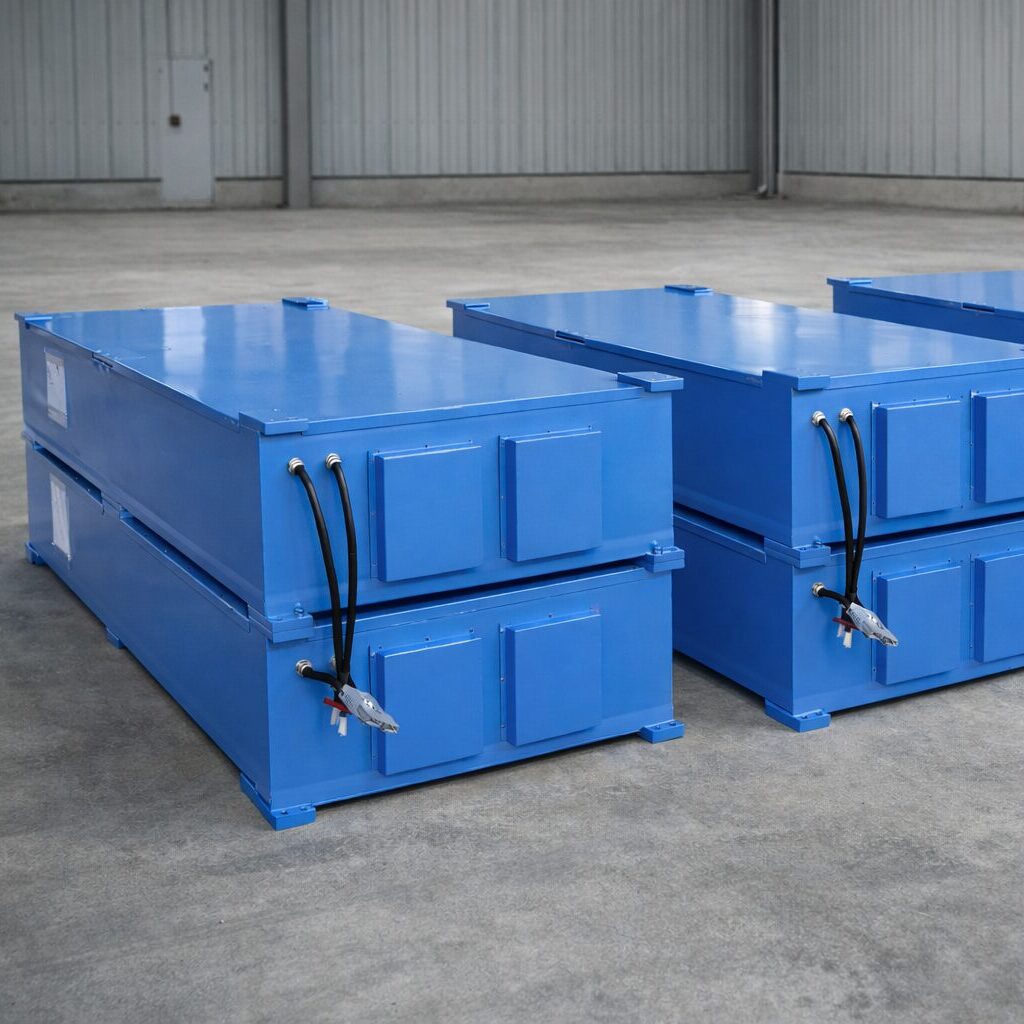
High-voltage LFP battery for rail vehicles
Aliant Battery has developed a high-voltage LFP battery designed for railway maintenance vehicles, an application that requires high power, operational reliability, and resistance in harsh environmental conditions. The vehicle manufacturer required an energy solution capable of powering work equipment with high current peaks, while ensuring operational continuity during prolonged interventions on the railway network. The solution developed includes an 800Ah high-voltage battery integrated into a hybrid system, capable of recharging both via the mains and via an on-board diesel generator, ensuring maximum operational flexibility even in areas without charging infrastructure.
Operational requirements for railway maintenance
Railway maintenance vehicles must operate in particularly demanding conditions, often in exposed environments and for long periods of continuous work. In this context, the battery must guarantee:
- High reliability over time, even with intensive work cycles
- Ability to deliver high inrush currents to power operational equipment
- Resistance to weather conditions and climatic variations
- Robustness against vibrations and mechanical stresses typical of railway vehicles
- Energy autonomy for extended operations
LFP (Lithium Iron Phosphate) technology was chosen for its chemical stability, long operating life, and safety, which are essential characteristics for industrial and railway applications.
Scalable modular architecture
To meet the project requirements, Aliant Battery developed an architecture based on scalable 400Ah battery modules, combined to achieve the required total capacity of 800Ah. This modular configuration offers numerous operational advantages:
- Service continuity: in the event of a fault in a single module, it is possible to isolate the unit while keeping the rest of the system operational.
- Scalability of energy capacity to adapt to different vehicle configurations.
- Greater design flexibility for railway vehicle manufacturers.
The modularity of the system is not only a technical advantage, but also an important benefit for manufacturers who produce different types of railway maintenance vehicles. Using the same battery architecture across multiple models allows for:
- Standardizing energy components
- Reduce spare parts inventory
- Simplify design and integration
- Optimizing maintenance activities
- Manage fleets of operational vehicles more easily
This strategy enables manufacturers to reduce operating costs and increase the operational efficiency of rail fleets.
Performance and reliability for railway applications
Thanks to the combination of LFP technology, modular architecture, and integration with a diesel-electric hybrid system, the solution developed by Aliant Battery guarantees:
- High energy availability
- Power for high-consumption equipment
- Resistance in harsh operating environments
- Service continuity even in the event of partial failure
- Long operating life
This solution demonstrates Aliant Battery’s ability to develop customized energy storage systems for industrial and railway applications with high operational intensity.


