Cell, module, battery, and energy storage system What they are and their differences.
Understanding the Architecture of Modern Energy
Electrification is transforming vehicles, industrial machinery, power plants, and energy storage systems. However, terms such as “cell,” “module,” “battery,” and “energy storage system” are often used interchangeably, leading to confusion.
In reality, these are distinct elements that represent different levels of complexity within the same energy architecture.
Understanding these differences is essential for anyone who needs to design, purchase, or simply evaluate an energy storage solution.
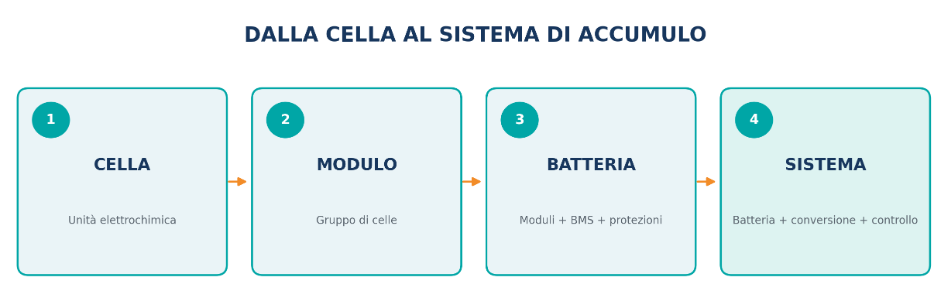
The hierarchy of energy storage.
From the atom to the system: a simple analogy
To understand the structure of a storage system, we can compare it to a building:
A cell is a single brick.
A module is a wall made up of multiple bricks.
A battery is the entire building.
The storage system is the complete complex, including electrical systems, energy management, and connections to the outside world.
Each level serves a specific purpose and adds value to the one before it
What is a cell?
An electrochemical cell is the basic unit that generates and stores electrical energy. It is the smallest component of a battery and is where the conversion between chemical energy and electrical energy takes place. Inside a cell, there are:
Anode
Cathode
Electrolyte
Separator
During discharge, chemical reactions produce electricity; during charging, the process occurs in reverse.
Is a single cell useful?
Technically, yes, but only for very low-power applications. A single lithium iron phosphate (LiFePO4) cell, for example, provides a nominal voltage of about 3.2 V. To power an industrial vehicle, an energy system, or a piece of heavy equipment, much higher voltages and capacities are required. For this reason, the cells are connected in series.
The Different Shapes of Cells
The cells can be manufactured in different sizes:
CYLINDRICAL
They are characterized by a sturdy construction and good mechanical strength. Typical applications:
Power Tools
Light Mobility
Electronics
PRISMATIC
They have a rectangular shape that allows for very efficient use of the available space. Typical applications:
Commercial Vehicles
Construction Equipment
Stationary Systems
POUCH
They use flexible casings that allow for high energy density and low weight. Typical applications:
Automotive
Aerospace
Pocket devices
What is a cell in a battery?
When multiple cells are connected together, the result is a module. The module represents the first level of industrial aggregation of cells. Its function is to:
Increase the available voltage or current
Increase the system’s overall energy capacity
Facilitate assembly and maintenance
Ensure greater mechanical strength
In a module, the cells are integrated with:
Mechanical components that ensure structural integrity
Electrical connections
Monitoring sensors
Safety systems
Why use modules?
Scalability: Batteries of various sizes can be built using the same module as the basic building block.
Standardization: Reduces design and mass production lead times.
Simplified maintenance: In some systems, individual modules can be replaced without having to replace the entire battery pack.
Greater reliability: Thermal and mechanical management can be optimized for groups of homogeneous cells.
What is a battery?
A battery is an organized assembly of one or more modules or cells, complete with all the elements necessary for coordinating the internal components and communicating with the rest of the vehicle. In an industrial context, the term “battery” generally refers to a system that is ready to be safely installed on a vehicle or machine but requires careful integration with the other peripherals on the vehicle.
A modern battery essentially consists of:
Cells
Modules
Power wiring
Fuses
Contactors
Sensors
Electronic management system (BMS)
Modular mechanical structure
The battery therefore represents the first stage of the energy that can be used by the end application.
The fundamental role of the BMS
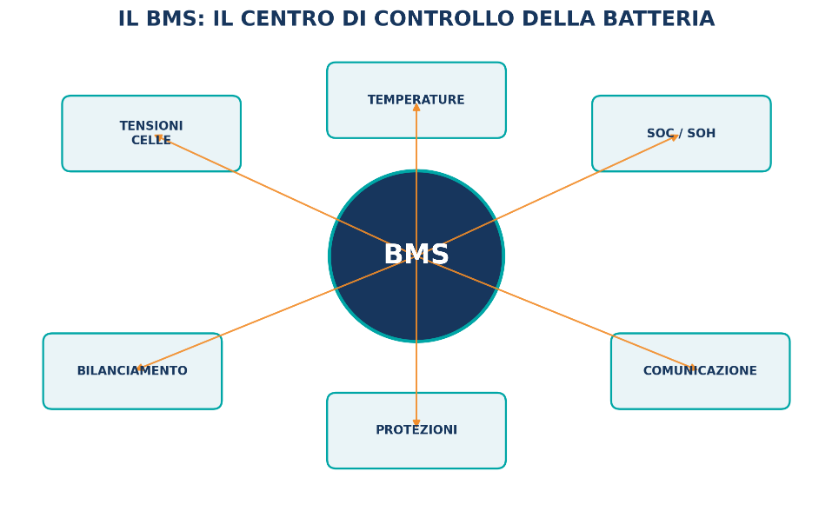
It can be considered the “brain” of the entire battery pack. Its functions include:
Monitoring the voltage of each cell
Temperature monitoring
Calculation of State of Charge (SOC)
Calculation of State of Health (SOH)
Cell balancing
Protection against overcharging and over-discharging
Communication with the vehicle or an external system
Without an advanced BMS, even the best cell technology could not guarantee safety, reliability, and longevity. See more about our BMS here
Main Functions of the Battery Management System (BMS)
The Difference Between a Battery and an Energy Storage System
One of the most common misconceptions is to think of a battery and an energy storage system as the same thing. That is not the case.
What does a storage system consist of?
Batteries: They serve as the reservoir in which energy is stored.
BMS: Manages and protects the batteries.
Charger: Converts energy from the grid or other sources into a form suitable for charging.
Inverter: Converts the direct current from the batteries into alternating current that can be used by electrical appliances and regulates its output.
Safety systems: May include:
Power line disconnect switches
Indirect contact protection
Thermal monitoring
Earth leakage detection and protection
Fire suppression systems
Ventilation or cooling
Communication interfaces: Enable integration with:
Vehicles
Machinery
Photovoltaic systems
Electric grids
Supervision systems
Battery
Energy Storage System
Stores energy
Stores and manages energy
Includes cells, modules, and a BMS
Includes a battery, inverter, charger, and controls
Supplies direct current
Can supply energy usable by the end application
Is an advanced component
Is a complete solution
In other words, the battery is the heart of the energy storage system, but the system includes many other components that are essential for it to function properly.
Conclusion
Every energy storage system is based on a well-defined hierarchical structure.
The cell is the fundamental unit that stores energy. Multiple cells form a module; multiple modules make up a battery; and the integration of the battery with control electronics, chargers, inverters, and management systems creates a complete energy storage system.
Understanding this architecture means understanding how the energy that powers electric vehicles, industrial machinery, renewable energy systems, and next-generation storage applications is generated, managed, and made available.
For this reason, when evaluating an energy solution, it is not enough to simply ask which battery is used: the real difference often lies in how the cells, modules, battery, and system are designed to work together.
Slide
Il vostro viaggio nel mondo dell’elettrificazione inizia da qui!